Grit
Key Insights
Grit is a person’s perseverance to keep putting effort into reaching a long-term goal one is passionate about
Reaching a goal in one life domain feeds your confidence, making it easier to reach goals in other domains
After school, my son often reads on his bed while I work. My office has been in his bedroom since COVID. Although I share a nice home office with my husband, it was impossible to work in the same room as he is in meetings every hour of the day. It does not seem to bother my son. He asks me, “Do you know what grit is”? My interest is piqued. I know what grit is, but what does he know about it? So I ask him: “What do you think it is?” “Grit is building self-toughness. It is about persistence and sticking with a long-term goal”.
I ask my 9-year-old where he has learned about grit. His school organized a special workshop to prepare kids for challenges. It was part of an anti-bullying module. It also taught them that life is not always fun, but that you can overcome setbacks by building self-toughness. I should really write a thank-you note to my kid’s school. I would much rather have him follow more grit workshops over circling silent letters in words that the English language probably should have dropped to make everyone’s life easier (knock, pterodactyl, doubt - those words).
Thinking about it, grit is probably the one thing I am actually good at. I have been an all-rounder my entire life. I am typically decent at most things I do, but I don’t feel exceptionally good at anything. I vividly remember myself curled up on the couch during lunch hour when I was about eight or nine years old. I was upset because, in my eyes, my best friend was better at everything. She was better at math, the best at gymnastics, and prettier. My mom had no idea how to respond. “There are things you are good at”, she tried. “Like what?” I retorted. I’m sure she gave some examples, but I only remember finding none of them convincing.
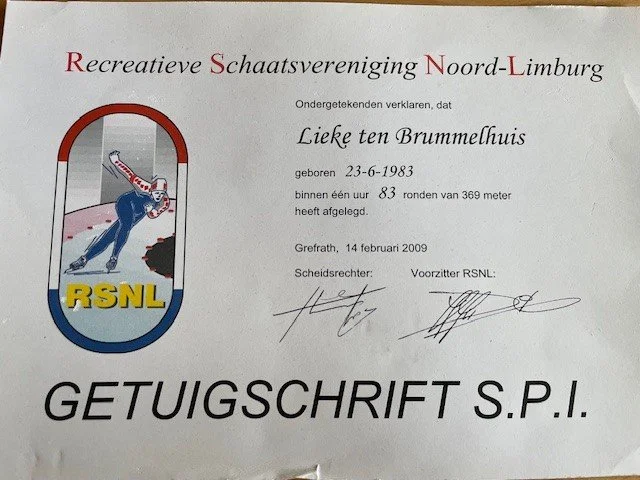
About eight years later, I had a similar conversation (without tears) with my cousin. He’d joined us on a family road bike vacation in the French Alps. When I shared that I felt I was not truly good at anything, he said: “The world needs all-rounders too, we can’t all be superstars. Being a superstar takes up all your time. You get to do a variety of things.” I mulled this over for a while and decided he was right. I thought about Ireen Wust, the most successful Dutch Olympic speed skater in history, whom I raced against when I was maybe ten or eleven. She was three years younger and already much, much faster. I can imagine that being a top athlete means dedicating 98% of your time to becoming or staying the best. Instead, I played in an orchestra, played field hockey, and did a bunch of different endurance sports (road biking, speed skating, running). I also had a solid group of friends, loved my family, and did well in school and later in university. And in every single thing I did, I had grit.
I barely ever give up, to a fault. Even last week, I biked up Mount Seymour (12.5km, 887m elevation) on an empty stomach. Stupid. But not reaching the top just wasn’t an option. So I got there. And I was hungry and cold. But I still did it, and it was awesome. I hadn’t reached the Mt Seymour peak since before my daughter was born. It gave me such a boost that I felt more confident at work, too. I found the courage to dust off a theory paper that I started years ago. And finished it. A fellow scholar reached out with an idea for a possible collaboration. We explored it with energy and enthusiasm. Grit can work as an upward spiral. You accomplish something in one domain because you persisted. And it gives you the confidence to try hard in another domain, too.
On a small, daily scale, I researched this idea two years ago with Professors Charles Calderwood (Virginia Tech), Chris Rosen (University of Arkansas), and Allison Gabriel (Purdue University). We asked 75 people who regularly exercise to wear a Fitbit for a week, and to fill out four short logs each day. We wanted to know if working out in the morning or at lunchtime boosted work performance afterward. Sure enough, coworkers rated their colleague as more efficient and with better work focus after a workout. Why was this the case? Because employees felt more confident about themselves after their workout. Grit in exercise helped them persist in work tasks.
Still sitting behind my desk in my son’s room, I see my son flinch when he moves his leg. “What is wrong with your leg?” I ask. “It’s nothing, it’ll be gone in the morning”. He has his mind set on running over 100km at the Kilometer Club at school. “Maybe you should take a break from running tomorrow”, I suggest. “No way, tomorrow is Wednesday, and we get to run during lunch hour”. That explains why he hasn’t been eating his lunch on Wednesdays lately. I sigh. I know that nothing is going to change the mind of this gritty boy. He is going to come home with that 125k ribbon.